
Few questions feel as urgent today as the question of identity. In a world shaped by constant movement, public self-definition, and relentless visibility, people are increasingly expected to explain who they are—often before they have had the space to understand it themselves.
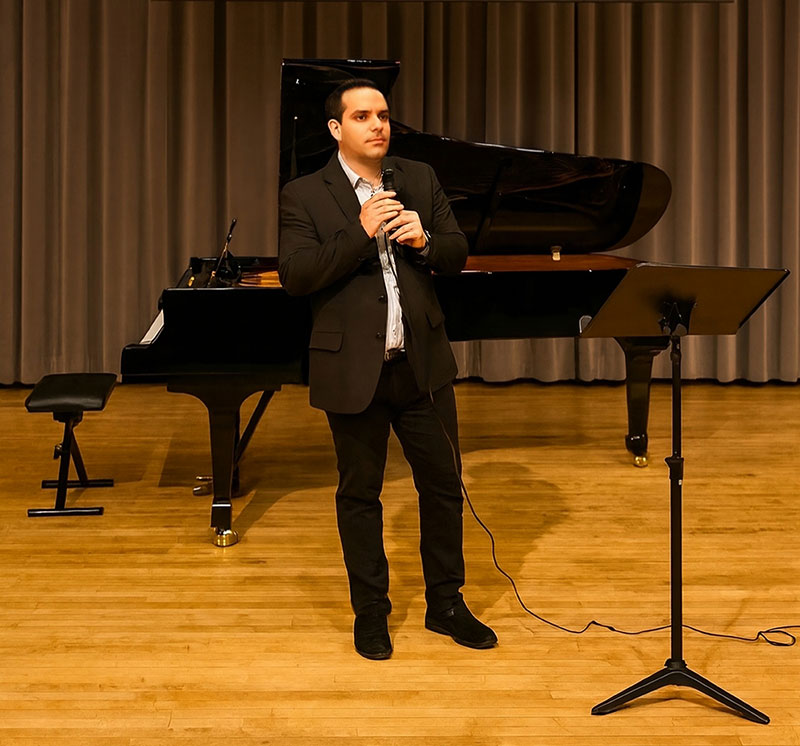
Johnny Hachem is an internationally active composer, pianist, writer, and public speaker, and the recipient of more than twelve international awards in composition. His work and professional presence have extended to over fifty countries, through performances, orchestral collaborations, radio and television broadcasts, and institutional, artistic, and advisory roles within musical and cultural contexts. Now based in the United States, Hachem brings to the conversation a perspective formed not by a single place or discipline, but by sustained engagement with diverse cultural worlds.
Asked how he approaches identity, Hachem does not begin with biography or labels. He begins with what remains when they fall away.
“We’ve turned identity into something visible—titles, affiliations, roles,” he says. “But identity is internal. It’s where conscience lives. It’s what governs how we act when there’s no audience and no reward.”
Living between cultures, he argues, doesn’t weaken identity. It tests it—and clarifies it.
“I think of identity as a backbone,” Hachem explains. “It allows movement without collapse. Displacement doesn’t erase who you are. It reveals what was essential and what was only habit.”
Belonging, he suggests, is often misunderstood. In many cases, it comes with an unspoken demand: to erase parts of oneself in exchange for acceptance.
“Belonging that requires self-amputation isn’t belonging,” Hachem says. “Some of the most necessary voices in any society come from people who don’t fit perfectly. They still see clearly because they haven’t traded themselves for comfort.”
When the conversation turns to pain, Hachem avoids both denial and dramatization. His emphasis is on integration.
“The goal isn’t to deny pain or to build identity around it,” he says. “It’s to integrate it. Denial fragments the self. Integration strengthens it.”
Faith enters the discussion quietly, without slogans or spectacle. For Hachem, belief is not a public badge but a private discipline.
“Faith isn’t performance or escape,” he reflects. “It’s a posture of the heart—a willingness to remain honest before God, even when answers are delayed or absent. Christianity doesn’t promise control. It calls for humility. And humility is not weakness; it’s the courage to stand in truth without demanding certainty.”
In a culture driven by constant visibility, Hachem sees a growing confusion between identity and image.
“We’re living in an age of permanent performance,” he says. “People manage an image instead of inhabiting a life. A grounded identity doesn’t need constant exposure. It has weight. It can afford silence.”
For those who feel pulled between different versions of themselves, his advice is direct.
“Stop asking who you should become,” Hachem says. “Ask what you’re betraying. Identity reveals itself through loyalty—to truth, to responsibility, to what persists even when it’s inconvenient.”
In a time that rewards speed, certainty, and visibility, Hachem’s reflections offer a quieter alternative: identity not as something to be displayed or perfected, but as something to be protected—shaped by conscience, strengthened through humility, and sustained by fidelity to what endures when the noise fades.