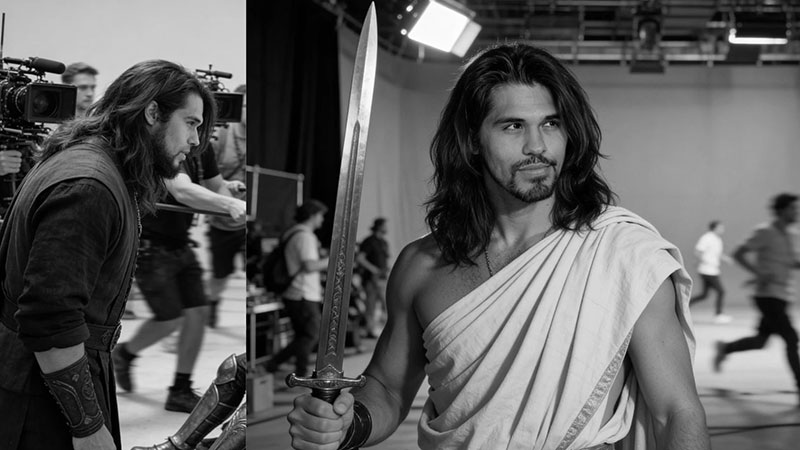
In the upcoming dark fantasy epic The Prince, The Sister & The Serpent, Abraham Mejorado steps into the sandals of Cadmus, a prince pulled into a world shaped by gods, prophecy, and irreversible choices. Known for his work as a producer in both digital media and independent film, Mejorado now takes center stage in a role that demands emotional restraint, physical presence, and an understanding of mythic tragedy. In this exclusive interview, he opens up about the themes of the script, the pressure of portraying a legendary figure, and why Cadmus feels deeply personal to him.
Cadmus is a mythological figure, but this script feels grounded and emotionally raw. What drew you to the role?
Abraham Mejorado: What really hooked me was that this isn’t a distant, marble statue version of Cadmus. He’s human. He’s flawed. He makes decisions that feel justified in the moment and catastrophic later. The script explores destiny, but it doesn’t treat it like something glamorous. It feels heavy. It feels like a consequence. I’ve always been drawn to characters who carry that weight, who aren’t perfect heroes but people navigating impossible circumstances. That felt honest to me.
The themes of fate and consequence run throughout the story. How did you approach that as an actor?
Mejorado: I tried not to play the myth. I played the man. When you think too much about prophecy or legacy, it can become abstract. What helped me was focusing on Cadmus’ immediate emotional reality. He’s searching for meaning. He’s trying to protect what he loves. He’s wrestling with pride and doubt at the same time. If you ground those moments in something relatable, the larger mythic elements take care of themselves. I’ve always believed audiences connect to vulnerability more than spectacle.
There’s a tension in the script between ambition and humility. Cadmus wants to build something lasting, but he’s constantly confronted with forces beyond his control.
Mejorado: That tension is the heart of it. Cadmus believes he can shape his own destiny, and in many ways he does. But every choice has ripple effects. I think that’s something modern audiences understand. We live in a time where people are constantly trying to define their own paths, but the world pushes back. Playing that internal conflict was challenging because it’s subtle. It’s not always loud. Sometimes it’s in silence, in hesitation before a decision. I learned over time that restraint can be more powerful than a dramatic outburst.
What are the biggest challenges of playing him?
Mejorado: Balance. Cadmus can’t come across as arrogant, but he can’t be passive either. He has to feel capable, even when he’s wrong. Physically, there’s the presence aspect. You’re playing someone who stands in front of the gods. You have to carry yourself a certain way. Emotionally, the challenge was not letting the weight of the mythology overwhelm the performance. I didn’t want it to feel theatrical. I wanted it to feel lived in.
You’re also producing the film. How does that dual responsibility affect your performance?
Mejorado: It forces you to be disciplined. When I’m acting, I have to trust the team. You can’t be in your head about budgets or logistics while you’re in a scene. At the same time, producing gives you a bigger picture perspective. You understand how every performance fits into the overall rhythm of the film. I’ve learned from working in digital media and film that efficiency matters. Preparation matters. So I show up ready, do the work, and then step back. That professionalism actually frees you creatively.
The film blends traditional storytelling with modern digital craftsmanship. Did that influence your approach?
Mejorado: Absolutely. We have artists on this project who come from decades of video game cinematic experience. They understand immersion and visual precision in a way that’s incredibly detailed. That environment pushes you as an actor because everything is intentional. There’s no room for laziness. The visuals are epic, but the emotional beats still have to feel authentic. That contrast makes it exciting.
Cadmus faces moral ambiguity throughout the story. Do you see him as a hero?
Mejorado: I see him as human. I don’t think the script is interested in labeling him. He does brave things, but he also makes mistakes. That’s what I love about it. The audience can decide how they feel about him. I think the most interesting characters live in that gray area. They reflect parts of ourselves we don’t always want to admit.
Was there a particular scene that stayed with you?
Mejorado: There’s a moment where Cadmus realizes that the very thing he fought for might cost him everything. It’s quiet, but it’s devastating. Those are the scenes I cherish as an actor. You’re not performing for applause. You’re sitting in truth. I think that’s where cinema becomes powerful.
How has this role shaped you personally?
Mejorado: It reminded me that ambition comes with responsibility. Cadmus wants to build something lasting, and that resonates with me as a producer and creator. But the story asks what you’re willing to sacrifice and whether the cost is worth it. That’s a question that doesn’t go away when the cameras stop rolling.
As The Prince, The Sister & The Serpent prepares for production, Abraham Mejorado’s portrayal of Cadmus promises a performance rooted not in grandiosity but in emotional clarity. By grounding myth in humanity, he brings a timeless figure into sharp modern focus. For Mejorado, stepping into the role was not about embodying legend. It was about revealing the unique, determined man beneath it.